Download our retail playbook now.
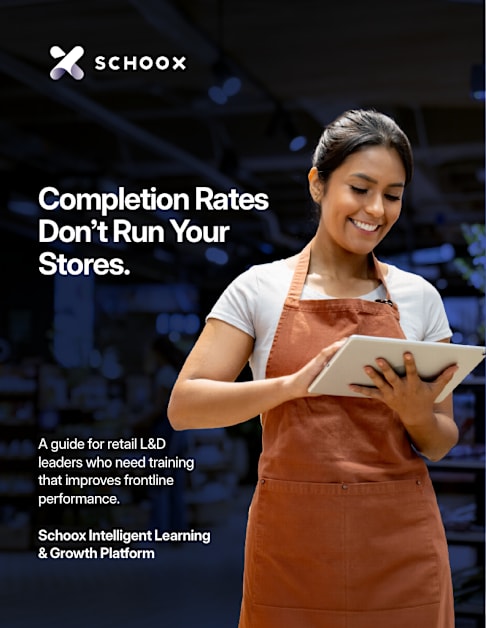
Completion Rates Don’t Run Your Stores.
A guide for retail L&D leaders who need training that improves frontline performance.
Schoox Intelligent Learning & Growth Platform
2Completion Rates Don’t Run Your Stores.
Introduction Comp sales, conversion, basket size, customer satisfaction, shrink, retention, time-to- productivity, and brand consistency—these are the outcomes retail leaders live by. Each of them is driven by how consistently frontline teams execute across stores, managers, shifts, and regions.
In retail: • The customer makes decisions in-the-
moment, in the store
• Standards are defined centrally
• And performance can vary at every site
When training doesn’t translate into repeatable behaviors on the sales floor, in the warehouse, or in operations, performance gaps appear:
• Inconsistent customer experiences
• Missed sales and upsell opportunities
• Slower time to productivity
• Brand standards applied inconsistently
• More operational variance from one location to the next
Most retail organizations already provide training in some form. The real question is whether that training builds the skills that improve consistent execution, or simply tracks that training happened. That distinction matters in retail because frontline behaviors shape the outcomes the business actually cares about: sales, service, speed, consistency, and retention.
The best retail organizations treat skills development as a business lever that directly influences store performance, not as a support function.
3Completion Rates Don’t Run Your Stores.
Why Most Retail Training Systems Fall Short Retail leaders are asked to drive consistent performance across a distributed frontline workforce.
Most traditional learning systems answer administrative questions:
• Who completed training?
• Who is overdue?
• Which modules were assigned?
Those questions matter, but they’re not the questions retail operators actually need to answer:
• Which employees are delivering the best customer experience?
• Where are selling behaviors breaking down?
• Which managers are developing strong teams—and which aren’t?
• Are new hires becoming productive quickly?
• Where is inconsistency affecting store performance?
These are performance questions. They signal the difference between tracking training activity and building workforce capability at scale. An intelligent learning platform should do more than deliver training courses. It should also identify where skills gaps exist, help employees build the specific skills that improve specific store performance outcomes, and develop people based on their learning style and in the flow of work.
Revenue Growth Depends on Frontline Execution Consistency Revenue in retail is won or lost at the point of interaction:
• An associate asking the right discovery questions
• A cashier suggesting an add-on
• A store leader coaching a team member in the moment
• An employee overcoming a buyer’s hesitation before it becomes a lost sale
• A team consistently executing promotions the way the brand intended
These are learnable, repeatable behaviors, not random outcomes. Revenue performance is influenced by frontline actions that an intelligent learning platform can help develop at scale, yet many retail organizations still deliver training as though these behaviors will develop naturally over time.
Without a structured approach, some stores consistently outperform while others underperform with no clear explanation. A better approach is to identify the specific behaviors that drive conversion, basket growth, loyalty, and service, then deliver purpose-built and on-brand learning to develop those skills and reinforce them in the context of daily work. Leading retailers are working collaboratively with L&D to take a more strategic approach to learning that identifies which revenue-driving skills are required by each job role and deliver targeted training to close any gaps.
4Completion Rates Don’t Run Your Stores.
Customer Experience Is a Skills Consistency Problem Customers don’t experience your brand at headquarters. They experience it in a store, with a person, in the moment.
In retail, customer experience can vary more than leaders anticipate. Teams may have access to the same training materials and still execute differently, interpret service standards inconsistently, or handle customer needs poorly.
Standards can exist in official documents without being translated into specific customer interactions. Operational change only becomes consistent when employees understand what the best practices are, can apply the right behaviors in-the- moment and receive reinforcement as the work happens.
The best-performing retail organizations don’t wait for NPS scores, reviews, or mystery shopper results to tell them where execution is breaking down. They proactively build the capabilities that create consistency, leveraging AI to help surface skills gaps across stores and deploy specific training reinforcement before customers notice the difference.
5Completion Rates Don’t Run Your Stores.
Sales Performance Is a Trained Capability Retail performance is often determined during short, high-impact interactions:
• A recommendation
• A cross-sell
• A loyalty sign-up
• A fitting-room conversation
• A return turned into a save
• A promotion explained clearly and confidently
These moments are often treated like reminders or scripts, but performance can vary if selling isn’t treated like a skill that requires practice. Conversion performance improves when employees receive targeted training, feedback, and reinforcement. It improves even more when the business can identify which selling behaviors matter most by role and where individuals require additional development.
6Completion Rates Don’t Run Your Stores.
Retention Improves When Growth Is Visible Employees stay longer when they are developed, feel capable, and can see career progression or feel confident in their role. They leave when they feel unsupported, uncomfortable, or for those with long-term career aspirations, unclear about their growth opportunities.
Visible skill development and career progression are among the strongest drivers of retention, but many legacy learning systems are better at documenting learning for managers than making growth visible to the employees doing the work. That’s a missed opportunity.
Retention improves when employees can see the skills they’re building, understand where those skills lead, and recognize their own progress over time. Intelligent learning platforms can help close those gaps by supporting continuous development based on observable skills and digital signals and delivering relevant training content that continues skills progression that alleviates retention risks before it becomes a problem.
7Completion Rates Don’t Run Your Stores.
Labor Efficiency Varies Based on Time-to- Productivity In retail, onboarding is constant. Every delay in productivity carries a real cost:
• Lost selling time
• Manager strain
• Higher labor inefficiency
• Inconsistent service
• Slower execution during peak periods
Time-to-productivity is one clear metric to demonstrate whether training is improving store performance. Organizations that shorten ramp time can improve service consistency, reduce team disruption, and optimize labor spend. That only happens when learning works the way retail employees work: short, role-specific, easy mobile access, and available in the flow of work. Top-performing retailers accelerate time-to-productivity by mapping required skills to each role and delivering purpose- built learning from day one — so new hires ramp faster.
8Completion Rates Don’t Run Your Stores.
Brand Standards Break Down During Store Execution Corporate leaders define brand standards. Regional leaders interpret them. Store managers reinforce them. Associates apply them. Every handoff creates the possibility of inconsistency, and a completion record does not guarantee understanding, confidence, or correct execution.
In distributed store environments, brand consistency depends on four things:
• Clear distribution of updates: the right people receive changes when they’re made
• Individual site variations are supported
• Consistent reinforcement: competency is developed, not just introduced
• Visibility into readiness gaps: someone can see problem areas before customers do
Intelligent learning platforms accommodate site variations by automatically ensuring updates reach the right roles with the right content, developing competencies at scale, and identifying where standards aren’t applied consistently before they become a brand problem.
9Completion Rates Don’t Run Your Stores.
Shrink, Errors, and Operational Waste Often Trace Back to Capability Gaps Retail losses aren’t only the result of theft or supply chain issues. They also stem from inconsistencies such as policy mistakes, poor product handling, pricing confusion, and handoffs between team members.
When employees are unclear of the standards, underprepared for edge cases, or unsupported in the moment, waste and inconsistency increase. Your learning platform should combine compliance, skills development, and operational intelligence to ensure these operational skills are developed by employees across all your locations.
10Completion Rates Don’t Run Your Stores.
11Completion Rates Don’t Run Your Stores.
What to Demand From Your Learning & Growth Platform Retail leaders should evaluate platforms against a single standard: whether they improve store execution. That question breaks down into eight key identifiers:
• Can it identify which skills impact the outcomes you care about most?
• Can it show where execution is inconsistent across stores?
• Can it support frontline employees in their workflow?
• Can it improve onboarding speed and time-to- productivity?
• Can it distribute updates across stores without manual effort?
• Can it make employee growth visible to employees, not just managers?
• Can it connect training to business performance before and after deployment?
• Can it use AI to map skills, identify gaps, personalize development, and improve outcomes over time?
These are performance questions, not feature evaluations. Retail organizations that outperform build consistent skill sets among employees across stores. They treat skills development as a system that connects frontline capability to sales, service, retention, and operational efficiency.
Skills don’t just remain at the individual level. Applied at scale, they become the organizational capability that defines the brand. When skills are built consistently, performance improves, variance decreases, and growth becomes easier to scale. A platform that checks boxes without building skills and improving outcomes is just a training delivery system rather than a strategic investment.
Next Steps Schoox is an intelligent learning and growth platform engineered with AI to identify workforce skills, surface gaps, and deliver targeted development to improve performance across every store, role, and team. The Schoox Learning Impact Suite maps skills to jobs, links those skills to business outcomes, generates learning plans for target goals, personalized reinforcement, and forecasts measurable impact before programs launch.
See how retailers are building the skills that move the metrics that matter.
Explore Customer Stories →
Ready to see what better training can do for your retail business?
Request a personalized demonstration
12Completion Rates Don’t Run Your Stores.
https://www.schoox.com/success-stories/ https://www.schoox.com/get-a-demo/