Hospitality Playbook
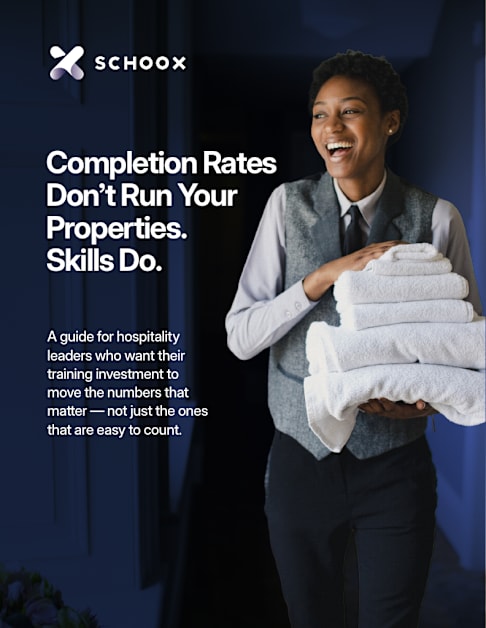
Completion Rates Don’t Run Your Properties. Skills Do.
A guide for hospitality leaders who want their training investment to move the numbers that matter — not just the ones that are easy to count.
Great Hospitality isn’t Logged. It’s Learned. RevPAR. Guest satisfaction. Retention. Labor efficiency. These are the numbers hospitality leaders live by and they are shaped every day by how consistently frontline teams execute every shift.
Most hospitality organizations already provide training in some form. The bigger question is whether that training helps employees build the skills that improve execution across properties, roles, and shifts — or simply records that training happened.
That distinction matters in hospitality, where execution gaps show up quickly in inconsistent guest experiences, slower ramp times for new hires, missed upsell opportunities, and uneven brand standards across locations. According to U.S. Bureau of Labor Statistics data, hospitality turnover consistently ranges between 70 and 80 percent annually, the highest rate of any industry sector in the United States. Operations run around the clock, and many organizations must onboard large seasonal cohorts within narrow timeframes.
While pricing, demand, and market conditions all shape results, the skills your frontline teams carry into every shift remain one of the most controllable inputs to performance. The strongest hospitality organizations do not treat training as a support function. They treat skills development as a core operational driver, one that directly shapes execution, consistency, and the metrics that define their business.
2The Restaurant Leaders’ Playbook
Why Traditional Training Systems Fall Short Most legacy learning systems answer administrative questions: Who completed the course? Who is overdue? Which compliance module was assigned? Those questions matter, but they are not the questions operators care about most.
Are front desk teams building the skills that improve upsell performance? Are service teams delivering a consistent guest experience across properties? Are new hires becoming productive fast enough to protect labor efficiency? Are managers able to spot readiness gaps before they show up in guest feedback, audits, or turnover?
That is the difference between tracking training activity and building a skills development capability.
A traditional LMS helps organize and report on learning activities. A modern hospitality training platform, like Schoox, should help leaders identify where execution is inconsistent, strengthen the skills tied to business performance, and support employees in the reality of daily work.
Hospitality leaders are responsible for revenue, guest satisfaction, retention, labor cost, and brand consistency. Training becomes strategically valuable when it helps drive those outcomes through better frontline execution — not when they generate a completion report.
3The Restaurant Leaders’ Playbook
Revenue Performance Depends on Frontline Skills Revenue performance is won or lost long before it appears in a report. It is earned in the check-in conversation, the room upgrade offer, the loyalty enrollment moment, the recovery interaction that prevents a poor review, and the consistency with which teams deliver the service standards that support premium pricing.
These are learnable behaviors. Yet many hospitality organizations still treat them like habits employees will pick up over time.
Without a more intentional approach, performance varies from property to property and shift to shift. One location consistently captures upgrade and loyalty opportunities while another misses them multiple times. When leaders cannot see where those skill gaps exist, it is much harder to improve revenue performance systematically.
A stronger approach starts with the specific behaviors that influence business outcomes. When operators identify the skills tied to those moments and reinforce them in context, they can improve consistency across the portfolio.
Sonesta Hotels saw a 5% increase in conversions after building guest-loyalty sales skills across their frontline teams — not by adding more training, but by developing the specific behaviors that drive enrollment conversations at check-in.
+5%
4The Restaurant Leaders’ Playbook
Guest Satisfaction Is Usually a Skills Problem Guests should not receive one experience at a property in Nashville and a very different one in Dallas — but that is often what happens when standards are documented centrally and applied inconsistently at the property level.
This is often described as a staffing issue, and sometimes it is. But just as often, it is a skills problem. Teams may have access to the same training materials and still fail to build the same behaviors. A standard does not become real simply because it exists in a course. It becomes real when employees are clear about what good looks like, can apply the right behaviors under pressure, and receive reinforcement where the work happens.
When that does not happen, guest experience management becomes reactive. Teams wait for survey scores, reviews, or complaint trends to tell them where service is breaking down. The operators who protect their satisfaction scores across a portfolio are the ones who can see where skills are being built and where they are not, and close that gap before it becomes a guest experience failure.
That matters in an industry where rising guest expectations, loyalty program pressures, and public review platforms make service consistency both harder to maintain and more critical to the business.
5The Restaurant Leaders’ Playbook
Loyalty Enrollment Is a Skill, Not a Reminder Enrollment in loyalty and rewards programs often comes down to a short conversation at check-in. In that moment, the employee needs to make the ask naturally, explain the value clearly, and handle hesitation without sounding scripted.
Organizations that treat loyalty enrollment as a reporting issue often underinvest in the skill-building required to improve it. They distribute scripts, reminders, and talking points, then wonder why results vary so widely across properties. A script may support performance, but it does not replace the skill. Enrollment consistency improves when the underlying behaviors are practiced, reinforced, and connected to the realities of the guest interaction.
The difference between a script and a skill is practice, reinforcement, and feedback in context. The operators who move loyalty enrollment numbers consistently are the ones who treat it as a trained capability rather than a talking point.
“With Schoox, we have increased training completion rates and can now easily see who has the skills necessary for a job. We had no line of sight into that beforehand.
— VP of Learning, Sonesta Hotels
6The Restaurant Leaders’ Playbook
Retention Improves When Growth Is Visible Job confidence, career development visibility, and manager support all influence retention but hospitality organizations often treat turnover as structural, a cost of doing business in a seasonal, hourly workforce.
Seasonality and labor competition are real. But turnover is an outcome, not a given. It responds to inputs. Employees who feel uncertain, unsupported, or stuck are far more likely to disengage. Employees who are building confidence, seeing their own progress, and understanding what comes next have a stronger reason to stay.
Many traditional learning platforms make completion visible to managers but not to employees. A stronger approach helps employees recognize the skills they are building, understand how those skills connect to performance, and see a path forward — not just a compliance checklist. That visibility is what moves retention in a workforce that has historically viewed hospitality roles as temporary.
30-40%
Hospitality employers who invest in structured skills development and make career advancement visible to employees report retention rates 30 to 40 percent higher than the industry average in high-turnover roles. The pattern is consistent: when employees can see their own growth, they stay longer.
(Source: 2025 North America Hospitality Workforce Trends report)
7The Restaurant Leaders’ Playbook
Labor Efficiency Depends on Faster Ramp Time Onboarding speed and operational consistency directly affect labor efficiency. Every day a new hire is not fully productive carries a cost. In a high-turnover, shift- based environment, slower ramp times affect service levels, managers’ workloads, and labor costs simultaneously.
Many hospitality organizations still treat time-to-productivity as an informal concept rather than an operational metric. They know it matters but do not have a reliable way to improve it consistently across properties. The same issue appears in day-to-day execution: when standards are taught unevenly, reinforced inconsistently, or updated too slowly, teams improvise. That creates friction, wasted time, and avoidable cost.
When time-to-productivity is treated as a tracked metric, with a skills development input that can be optimized, hospitality operators carry a structural labor cost advantage over those that don’t.
$600K Sonesta Hotels saved $600,000 and reduced onboarding time by implementing faster, more structured new-hire training through Schoox — and consolidated $134,000 in tech stack costs by replacing fragmented learning tools with a single platform.
8The Restaurant Leaders’ Playbook
Brand Standards and Compliance Come Apart at the Handoffs Brand consistency and compliance depend on how clearly employees understand and apply standards. In multi-property hospitality organizations, those standards often break down across ownership structures, management layers, properties, and shifts. That is when compliance stops being a documentation problem and becomes a skills problem.
A completion record tells you training was assigned. It does not tell you whether the employee understood the standard, whether the manager reinforced it locally, or whether each role received the right update at the right time. In franchise and management company environments, the path from a central standard to frontline behavior involves multiple handoffs and every handoff is a place where the skill does not fully develop.
A stronger approach makes training updates easier to distribute, reinforcement more continuous, and readiness gaps more visible before they become audit findings or guest-facing failures. Platforms like Schoox support this through attribute- based architecture that deploys training by brand, property type, region, and role simultaneously — without manual reconfiguration at each layer.
9The Restaurant Leaders’ Playbook
10The Restaurant Leaders’ Playbook
What to Demand From Your Platform Assigning training and generating reports still matter. But they should not be the standard hospitality leaders use to evaluate a platform. A purpose-built hospitality training platform should be able to answer harder questions than that.
Can it identify which skills are tied to the outcomes we care about most? Not just which courses exist — but which specific skills impact RevPAR, guest satisfaction, loyalty enrollment, and retention. If your platform cannot make that connection, it is organizing activity, not driving performance.
Can it show us where execution is inconsistent across properties or roles? Visibility into skill gaps at the property and role level is critical — before they show up in guest reviews or performance reports. Reactive management is expensive. A platform should make readiness visible before it becomes a problem.
Can it support frontline employees in the flow of work — not just in scheduled training events? A housekeeper on a shared device in the middle of a shift has different access needs than a department head at a desk. A platform built for hospitality frontline workers serves both without compromise.
Can it improve onboarding speed without sacrificing brand consistency? Faster ramp and consistent standards are not in tension — they are the same problem. A platform that helps new hires reach full productivity faster, while applying the same standards across every property, solves both.
Can it adapt when standards change — and get the update to every affected role? Brand standard changes happen constantly in multi-property and franchise environments. A platform should distribute updates automatically, by role and property, with verification that goes beyond a completion checkbox.
Can it make employee growth visible to the employee — not just trackable by HR? Retention improves when employees can see the skills they are building and understand where those skills lead. A platform that makes progress visible to the employee — not just reportable to the manager — changes the retention equation.
Can it connect learning investment to operational performance? Not just through ROI calculations after the fact — but by forecasting the expected impact of a training program before it is deployed, and tracking whether that impact materializes in the metrics that matter.
11The Restaurant Leaders’ Playbook
The Difference Between Training a Workforce and Building One That Performs Hospitality organizations that outperform over time are not necessarily the ones doing the most training. They are the ones building more consistent skills across the frontline — intentionally, systematically, and with visibility into whether the investment is working.
Sonesta Hotels is one example of what that looks like in practice. Training employees across 15 hotel brands, they used Schoox to deliver more than 20,000 training hours and 50,000 course completions in their first six months on the platform while simultaneously reducing onboarding time, improving retention, and increasing guest bookings through targeted loyalty sales skills training. The result was not more training. It was better-prepared teams delivering more consistent execution across the portfolio.
A learning platform should support that work, not simply document it. Skills built consistently at the frontline level do not stay at the frontline level. Applied at scale, across properties, roles, and shifts, they become the organizational capability that separates high-performing hospitality businesses from the rest.
That is the difference between training a workforce and building one.
See Schoox in your environment
Read the Sonesta Hotels story in full — how they connected workforce skills development to RevPAR, retention, and guest satisfaction across 15 brands.
View the Sonesta case study →
Request a Demo
https://www.schoox.com/success-story/how-sonesta-hotels-leverages-schoox-to-ensure-employee-success-at-scale/ https://www.schoox.com/get-a-demo/