Download our manufacturing playbook now.
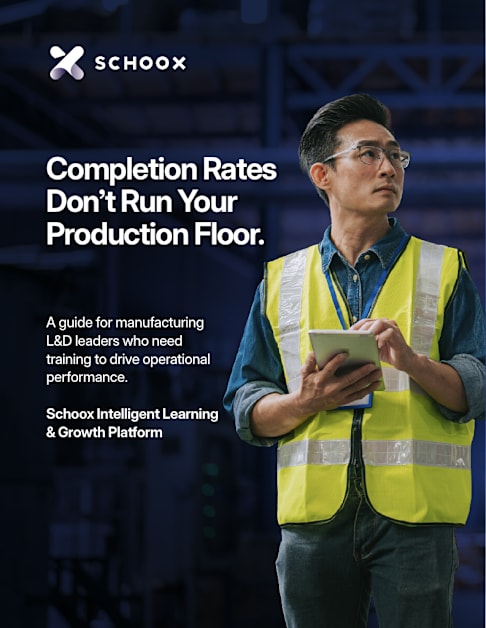
Completion Rates Don’t Run Your Production Floor.
A guide for manufacturing L&D leaders who need training to drive operational performance.
Schoox Intelligent Learning & Growth Platform
2Completion Rates Don’t Run Your Production Floor.
Introduction Quality, throughput, reliability, time to productivity, compliance readiness, implementation success, and workforce stability are some of the results manufacturing leaders live by. Each of them is influenced by how consistently frontline teams execute across lines, shifts, plants, and roles.
Manufacturing teams track the operational signals behind those outcomes:
• Defect rates
• RMA and field failure rate
• MTBF
• Yield impact
• Certification readiness
• Test pass rates
• Implementation time
• Incident rate
• MTTR
• Performance and error rates
Execution in manufacturing happens on the floor, not at a desk. Standards are defined centrally, but performance can vary from shift to shift, line to line, and site to site. When training doesn’t translate into repeatable behaviors in the flow of work, performance gaps appear:
• Costly errors and rework
• Slower time-to-productivity and greater understaffing pressure
• Higher safety and compliance exposure
• Inconsistent execution across teams
• More downtime, instability, and operational variance
Most manufacturing organizations already provide training in some form. The real question is whether that training builds the skills that improve execution on the floor, or simply records that training happened. That distinction matters in manufacturing because capability gaps show up quickly as defects, delays, safety incidents, failed audits, and avoidable instability.
3Completion Rates Don’t Run Your Production Floor.
Why Most Manufacturing Training Systems Fall Short Manufacturing leaders are asked to support workforce capability in environments defined by labor shortages, process complexity, compliance pressure, and constant demands for more consistency with less waste.
Most traditional learning systems answer administrative questions like “Who completed training?” and “Which certifications are assigned?” Those questions matter, but they’re not the questions manufacturing leaders actually need to be answered:
• Which lines are making preventable mistakes?
• Where are quality control issues repeating?
• Which teams are not reaching proficiency fast enough?
• Where is instability being caused by uneven execution?
• Which skills gaps are increasing risk on the floor?
An intelligent workforce learning system should help manufacturers identify where execution varies, build job-critical skills tied to operational outcomes, and support workers in the flow of work, where production decisions actually happen. The alternative is that inconsistent training leads to costly errors and rework, slow onboarding leaves teams understaffed and exposed, unverified compliance records increase safety and audit risks, and crews are left to absorb the gaps.
Operational Performance Depends on Workforce Readiness An operator following the right procedure under pressure, or a maintenance worker applying the correct safety process, isn’t a random outcome—they’re learnable, repeatable behaviors. Quality, stability, compliance, delivery, and reliability are all the result of what frontline workers do in the moment. An intelligent workforce learning system can develop those behaviors at scale, but many manufacturers still assume proficiency will develop naturally over time.
Without a structured employee development approach, some teams consistently outperform while others struggle. The better path is to identify the specific skills that drive production outcomes, build learning designed to improve those skills, and reinforce them at scale. That’s where AI adds real value — by surfacing skill gaps tied to business objectives, building more targeted learning plans, personalizing reinforcement, and forecasting program impact before launch. The result is a shift away from simply producing content faster and toward directly connecting goals, skills, learning, and measurable results.
4Completion Rates Don’t Run Your Production Floor.
Quality Problems Are Often Skills Problems First Defects, rework, and field failures are usually treated as quality problems, but they often start earlier as training and capability problems.
Workers can have access to the same SOPs and still interpret standards differently, set up equipment inconsistently, miss process deviations, apply quality checks unevenly, and troubleshoot errors too late.
Manufacturing leaders track the outcomes: defect rates, RMA and field failure rates, MTBF, and yield impact. These metrics also reflect whether employees can apply the right skills consistently under real operating conditions.
Performance requires more than simply documenting that training occurred. A high standard of work rests on whether employees understand what “good” looks like, can execute to standard, and receive reinforcement before mistakes become scrap, rework, or customer-facing failures.
5Completion Rates Don’t Run Your Production Floor.
Time-to-Productivity Directly Affects Labor Efficiency In manufacturing, onboarding isn’t just an HR milestone. It’s an operational variable. Every delay in time-to-productivity carries a real cost in the form of understaffed teams, lower throughput, pressure on experienced workers and greater risk exposure.
Time-to-productivity is one of the clearest indicators of whether a training system is helping operations achieve their goals or slowing them down. When new hires can’t access learning in the flow of work, or managers have no clear way to reinforce and validate skills on the job, ramp time extends, and performance suffers.
An intelligent learning system should accelerate readiness by standardizing onboarding, reinforcing job-critical skills earlier, and building confidence on the floor faster.
6Completion Rates Don’t Run Your Production Floor.
Compliance Readiness Should Not Depend on Unverified Records Manufacturers operate in environments where compliance is non-negotiable, yet so many organizations still rely on fragmented systems, manual reporting, and incomplete records to prove readiness. That creates real exposure at audit time, when certifications must be verified, a safety incident requires documentation, or a plant leader needs immediate visibility into training status.
Unverified records and incomplete readiness data leave manufacturers unprepared precisely when the stakes are highest, and when lack of visibility is most costly.
The better approach is to treat compliance as part of a broader performance system by making readiness visible by role, site, shift, and topic area. When leaders can see where gaps exist before an audit or incident forces the issue, compliance becomes a continuous, manageable process rather than a reactive event.
7Completion Rates Don’t Run Your Production Floor.
Safety Performance Depends on Execution in the Flow of Work Safety in manufacturing is about whether people can apply the right behaviors in the moment they’re needed. Building a safe workplace means developing employee competency across the areas that matter most on the floor:
• Hazard communication and chemical safety
• Physical and environmental hazards
• Electrical safety and lockout/tagout
• Equipment, tools, and machine guarding
• Ergonomics and hearing conservation
• PPE, safety audits, and incident investigation
Workers need safety knowledge in context: under pressure, during handoffs, around equipment, and in real-time response situations. When training isn’t integrated into the flow of work, readiness gaps surface in the moments that matter most and raise incident and audit exposure. When it’s reinforced where work happens, safety becomes more consistent, and workforce readiness becomes easier to verify.
8Completion Rates Don’t Run Your Production Floor.
Delivery Performance Suffers When Skills Do Not Keep Pace Manufacturing leaders track delivery outcomes such as implementation time, integration defect rates, and go-live success because these metrics reveal whether teams can execute change without disruption.
When new systems, processes, products, or standards are introduced without structured skill development, the pattern is predictable: ramp time increases, errors surface later, go-lives become riskier, and managers spend more time correcting than scaling.
Training shouldn’t sit beside operational change; it should support it directly, helping employees build proficiency faster and apply changes consistently from the start. That’s especially important in manufacturing, where even small execution errors can ripple across quality, throughput, and customer commitments.
9Completion Rates Don’t Run Your Production Floor.
Stability Depends on Faster Gap Detection and Reinforcement Stability in manufacturing organizations is often discussed as a systems issue. In practice, it’s also a workforce capability issue.
Incident rates, MTTR, and error rates all reflect how well teams respond under actual operating conditions. When skills are inconsistent, problems take longer to diagnose, errors repeat, response times slow, and experienced employees carry more of the load.
Leading manufacturing organizations don’t wait for breakdowns to reveal training gaps. Instead, they leverage the right tools to proactively identify readiness issues and address them before they become operationally expensive.
10Completion Rates Don’t Run Your Production Floor.
Reporting Should Help Leaders Act, Not Just Document Manufacturing leaders need reporting that makes risk, readiness, and performance gaps visible. When that visibility is built in, leaders spend less time assembling compliance documentation and more time acting on what the data shows.
In manufacturing, complete reporting processes are how leaders come to understand where capabilities are strong, where they’re missing, and where intervention is needed before quality, safety, or delivery suffers.
11Completion Rates Don’t Run Your Production Floor.
12Completion Rates Don’t Run Your Production Floor.
What to Demand From Your Intelligent Manufacturing Learning Platform Manufacturing leaders should evaluate platforms against a single standard: whether they improve operational performance. That question breaks down into eight key identifiers:
• Can it identify which skills drive the quality, safety, delivery, and stability outcomes you care about most?
• Can it show where skills gaps exist and execution is inconsistent across lines, shifts, plants, and roles?
• Can it support frontline employees in the flow of work — not just in scheduled training sessions?
• Can it reduce time-to-productivity and improve onboarding consistency?
• Can it make compliance and certification readiness visible without manual reporting?
• Can it reduce errors, rework, and instability by reinforcing skills before problems escalate?
• Can it connect training to metrics like defect rates, MTBF, yield impact, incident rates, MTTR, and go-live success?
• Can it use AI to map skills, identify gaps, personalize development, and forecast business impact before rollout?
These are performance questions, not feature questions. A platform that checks boxes without improving outcomes is more like a training delivery system than a strategic investment to drive business performance.
For manufacturing leaders, readiness is the product, execution is the differentiator, and skills are the capability behind both. Manufacturers that outperform don’t leave that to chance—they build workforce capability systematically across roles, shifts, and plants, and connect learning directly to quality, compliance, reliability, delivery, and operational stability.
Applied at scale, skills become the operational capability that drives plant performance. When employee skills are built consistently, errors decrease, ramp time shortens, compliance strengthens, and performance becomes more predictable. That’s the difference between simply managing training and building a workforce that performs on the floor.
Next Steps Schoox is an Intelligent Learning and Growth Platform engineered with AI to identify workforce skills, surface gaps, and deliver targeted development across every role, shift, and site. The Schoox Learning Impact Suite maps skills to jobs, links those skills to business outcomes, generates learning plans and courses for target goals, personalizes reinforcement, and forecasts measurable impact before programs launch.
See how manufacturing organizations are building the skills that move the metrics that matter.
Explore Customer Stories →
Ready to see it in your environment?
Request a personalized demonstration
13Completion Rates Don’t Run Your Production Floor.
https://www.schoox.com/success-stories/ https://www.schoox.com/get-a-demo/