Anchor: Header

Your training system says "complete." But can you see performance across every brand?

Speed of service. Check size. Guest experience. When workforce capability isn’t consistent across brands, locations, and concepts, it shows up immediately in your numbers.

When execution breaks down, it shows up differently across every brand

Most systems in place today were built to track training within a single brand. They weren’t built to ensure consistent execution across multiple concepts, operating models, and tech stacks. In multi-brand environments, performance gaps don’t show up in reports first. They show up during peak hours and they vary by brand, region, and concept.

Inconsistent execution across brands and locations

Different training standards creating variations in guest experiences

Missed upsell opportunities that impact total revenue

Operators re-training teams instead of running the business

New hires leaving before contributing to success

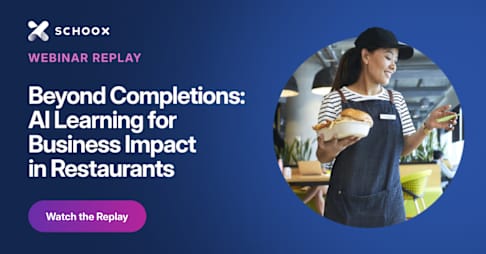
Beyond Completions: AI Learning for Business Impact in Restaurants

When training says “complete” but your floor tells a different story, it’s time for a smarter approach. Join us to see how high-growth restaurants are using AI to accelerate new hire readiness, drive consistent execution, and finally prove L&D’s impact on the bottom line. You’ll walk away with:
  • An outcome-first framework linking training directly to revenue, retention, and performance
  • AI tools that auto-generate role-specific content while keeping humans in control
  • A playbook for forecasting ROI before you commit resourcesStop measuring training activity.
Start measuring business results. Speakers: Sandra Moran, Chief Marketing Officer, Schoox; Ali Zaheer, Sr. Director Solutions Consulting, Schoox

What leading multi-brand operators do differently

Many multi-brand operators inherit fragmentation.
High-performers engineer consistency, setting the standards across every brand while giving each concept the room to execute within it.

Get new hires productive quickly, whether they move between concepts or stay within a single brand

The risk isn’t consolidating systems.
It’s not being able to support improved performance outcomes across the portfolio while you wait.

This isn’t about replacing one LMS with another.

It’s about moving from disconnected tools across brands to a single system that connects workforce capability to business performance.

What feels risky

Consolidating systems across brands feels complex

Each restaurant concept has different needs

Change management across brands feels difficult

Current tools “work” within each brand

What's actually risky

Operating with disconnected systems limits visibility and control

No shared view of workforce capability across the portfolio

Inconsistent execution continues across locations

Performance gaps compound across brands while you manage separate systems

Leading restaurant groups are consolidating their learning and workforce systems to:

You’re not just changing systems. You’re changing how performance is managed.

Reduce technology complexity across brands

Standardize where it matters, flex where it’s needed

Gain visibility across locations, regions, and concepts

Improve execution without slowing operations

What success looks like across a multi-brand portfolio

The difference shows up in how your brands perform, individually and together.
  • Leaders have one view of workforce readiness and execution risk across all brands
  • Managers spend less time managing training systems and more time running operations
  • New hires become productive faster, in each brand
  • Consistency improves without removing brand-level flexibility
  • Brand standards, service expectations, and upsell behaviors become consistent across every location and shift.
  • Employees see clearer growth paths across the portfolio, improving retention

How leading multi-brand operators drive consistent execution across every concept

Get a practical look at how multi-brand operators improve performance across concepts, from onboarding to ongoing execution.
  • Maintain consistent safety, service, and operational standards across brands
  • Roll out menu changes, promotions, and initiatives across multiple concepts quickly
  • Connect workforce development to outcomes like revenue per location, speed of service, and guest experience
  • Consolidate systems to reduce administration and improve data visibility

var(--fz-color-primary-3)

Anchor: FAQ

 Is your current approach built for multi-brand restaurant operations?

Can you see workforce capability across all brands in one place?

Most organizations rely on separate systems by brand, making it difficult to identify readiness gaps across the business. Leading teams create a unified view across all concepts.

Are you managing multiple learning systems across brands?

Many parent companies inherit different platforms through growth or acquisition. Consolidation reduces complexity while improving visibility and control.

Can you connect training to performance across the portfolio?

Training is often measured by completions within each brand. High-performing organizations connect workforce capability to business outcomes across all brands.

Can you maintain brand flexibility without losing consistency?

As brands grow, maintaining consistency becomes harder. Strong operators combine centralized standards with flexibility at the restaurant level.

Consistency across brands doesn’t happen by chance

The question isn’t whether training is happening within each brand. It’s whether your organization can ensure consistent execution across every concept, location, and shift without adding complexity. Leading restaurant groups don’t just manage training. They manage workforce performance across the entire portfolio.