Download our restaurant playbook now.
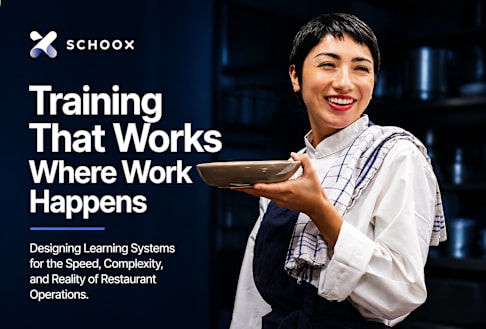
Training That Works Where Work Happens
Designing Learning Systems for the Speed, Complexity, and Reality of Restaurant Operations.
Training in restaurants doesn’t happen in classrooms or at desks—it happens between shifts, on the floor, and in the flow of daily operations.
Guest expectations continue to rise as restaurant labor tightens and operations become more complex. New menu items, promotions, safety requirements, staffing gaps, and constant change across dayparts and locations mean training is no longer a back- office function. It’s one of the few operational levers restaurants can use to protect consistency, readiness, and profitability.
Across restaurant operators, the pattern is consistent: when training is designed for frontline reality—and built to support execution, not just completion—restaurants see measurable gains. Faster new-hire ramp. Stronger retention. Lower operational risk. Reduced waste. Better execution where it matters most.
The challenge is that not all learning systems are built for restaurant environments.
Most restaurants already have some form of training or an LMS. The issue isn’t intent—it’s execution, scale, and speed.
2The Restaurant Leaders’ Playbook
Many learning platforms are intended for desk-based employees and scheduled learning, but were later adapted for restaurant work. That imperfect adaptation breaks down when learning must occur during shifts, across drive-thrus, prep stations, specialized equipment, and mixed-ownership models with hundreds or thousands of locations.
Common gaps include:
• Menus, promotions, and procedures change faster than training can be updated and translated.
• New equipment or layouts roll out without consistent, role-specific support.
• Managers struggle to align teams to corporate and franchise standards.
• Training can’t keep pace with the speed of daily operations.
These gaps aren’t caused by a lack of content. They’re caused by learning systems that don’t fit the realities of how work happens in restaurants. Instead of starting with tools, effective restaurant training starts with outcomes. This guide outlines eight business outcomes restaurant leaders consistently prioritize, and what learning and development teams should evaluate in technology if they expect training to deliver against them.
3The Restaurant Leaders’ Playbook
4The Restaurant Leaders’ Playbook
Eight Areas Where Restaurant Learning Drives ROI 1. Reduce Time Spent Creating and Managing Courses In restaurant environments, training content changes constantly: menus rotate, procedures evolve, and promotions roll out at speed. When course creation and updates are slow or manual, training quickly falls behind operations.
One fast-casual chain reported saving more than 500 hours per year on training administration and reducing costs by $40,000 after moving to a more effective, frontline-aligned learning platform.
Traditional LMS platforms break down when:
• Training materials require frequent updates and rework.
• Slight variations are needed by brand, region, or location.
• Administrative effort increases exponentially as locations grow.
• One-size-fits-all courses don’t adapt to individual learners’ skill proficiency.
Evaluate learning platforms that support:
• Flexible organizational structures that mirror roles, regions, franchises, and locations – without additional administration.
• Automated workflows for assignments, reminders, and recertifications.
• AI-engineered course creation to keep pace with menu and SOP changes.
• Purpose-built training tied to specific skills and operational outcomes (e.g., faster drive-through speeds, customer loyalty, sales growth).
• Broad content support (video, documents, interactive formats, SCORM/AICC/xAPI).
• Short, role-relevant assessments that support personalized skills development.
2. Reduce Time Spent on Reporting and Compliance Tracking Compliance is only valuable if it’s visible, reliable, and audit-ready. As restaurant operations scale, manual reporting quickly becomes unsustainable.
A 2,500-location restaurant chain reported a 50% reduction in effort required to run compliance reports after improving training workflows and system integrations, including franchised and owned location reporting requirements.
Traditional learning systems fail at scale when:
• Compliance data is difficult to locate or verify.
• Reporting requires manual exports and reconciliation.
• Corporate and franchise leaders lack local visibility into readiness and risk.
Evaluate platforms with:
• Audit-ready compliance reporting built specifically for restaurants.
• Flexible, non-hierarchical location tagging that reduces setup time.
• Custom reporting by role, location, equipment, or ownership model.
• Scheduled report delivery to stakeholders.
• Real-time dashboards showing risk, readiness, and verifications.
5The Restaurant Leaders’ Playbook
3. Reduce Time-to- Productivity
First impressions matter. In restaurants, effective onboarding directly impacts speed-to-competency, confidence, and early retention.
One restaurant enterprise reported a 57% faster time-to-productivity—from seven days to three—while reducing training administration effort by 95%.
Traditional LMS platforms struggle when:
• Training isn’t accessible during shifts or in the flow of work.
• Managers manually track on-the-job training.
• New hires receive too much content without guided practice.
Evaluate platforms that enable:
• Mobile-first access on any iOS or Android device.
• On-the-job training checklists with manager sign-offs.
• Automated, rule-based assignments by role or location.
• Coaching and social learning to reinforce skills through practice.
6The Restaurant Leaders’ Playbook
7The Restaurant Leaders’ Playbook
4. Improve Employee Retention Turnover is particularly costly in leadership and specialized roles.
Training plays a critical role in whether employees see a future with your organization. Employees who value their training experience are significantly more likely to be satisfied and less likely to leave. In restaurants, where career clarity is often limited, learning becomes a key strategy for employee retention.
Traditional systems fail employees when:
• Learning feels disconnected from their role and proficiency.
• Learning isn’t personalized based on preferred learning mode.
• Career progression is unclear or invisible.
• Training isn’t reinforced through coaching.
Evaluate platforms that provide:
• Clear visibility into required and emerging skills.
• Defined career paths tied to operational roles.
• Continuous coaching and feedback loops.
• Goals and KPIs aligned to business outcomes.
5. Increase Sales Through Consistent Execution In restaurants, revenue is driven by consistent execution across every shift and location. When menu knowledge, promotions, and service standards aren’t reinforced, performance varies widely, and opportunities are missed.
Traditional LMS platforms fail to impact revenue when:
• New menu training doesn’t reach all employees consistently.
• Promotions roll out unevenly across regions.
• Training isn’t reinforced after launch.
Evaluate platforms that support:
• Generate microlearning for rapid rollout and refreshers.
• Offer native mobile and multilingual access.
• Deliver reinforcement through assessments and coaching.
• Skill- and goal-based training sequences by role and location.
• Scalable communication tools for assignments and updates.
8The Restaurant Leaders’ Playbook
6. Reduce Insurance Premiums and Claims Safety training remains a top priority in restaurant operations. And when execution breaks down, it can quickly become a major cost driver.
One international franchise reported a 5% reduction in general liability claims and a 2.5% reduction in dram shop claims following improvements in training execution.
Traditional systems fail to manage risk when:
• Compliance tracking is incomplete.
• Training doesn’t reach every shift.
• Learning isn’t accessible when needed.
Evaluate platforms with:
• Real-time compliance dashboards.
• Audit-ready training records.
• Support for industry standards (SCORM/AICC/xAPI).
• Targeted, multilingual communications.
• Certified, ready-to-use compliance content.
9The Restaurant Leaders’ Playbook
7. Reduce Waste, Materials, and Shrinkage Inconsistent training leads directly to wasted ingredients, lost inventory, and inefficient processes.
One restaurant enterprise reduced food waste by 16% through consistent frontline training and accessible food-building guides.
Traditional systems fail to reduce costs when:
• Training isn’t available on the job.
• Reinforcement is missing after onboarding.
• Standards vary across roles and locations.
Evaluate platforms that enable:
• Standardized onboarding across the enterprise.
• Role- and goal-based learning workspaces.
• Training tied directly to operational outcomes.
• Blended learning with hands-on practice.
• Mobile and multilingual access.
10The Restaurant Leaders’ Playbook
Traditional LMS platforms keep costs high when:
• Multiple tools are required to fill capability gaps.
• Adoption remains low.
• Admin effort grows with every new location.
Evaluate platforms that offer:
• Architecture aligned to real organizational structures.
• Centralized content management for policies, SOPs, and training.
• Reinforcement in the flow of work for immediate access.
• Integrations with HRIS and security systems.
• Built-in communications and analytics.
8. Reduce the Total Cost of Learning Technology Organizations report up to a 90% reduction in technology costs when learning, communication, and collaboration are unified.
Fragmented learning stacks increase cost, risk, and administrative burden. When training, communication, and compliance live in separate tools, teams lose visibility and efficiency.
11The Restaurant Leaders’ Playbook
12The Restaurant Leaders’ Playbook
Next Steps: Is Your Current Platform Built for Restaurant Reality? Ask yourself:
• Can training be completed during shifts, in short, role-specific moments?
• Can managers reinforce and validate skills on the job?
• Can training scale across locations, drive-throughs, and franchises without multiplying admin work?
• Can learning keep pace as menus, equipment, and customer expectations change?
• Can training activity be directly tied to ramp time, safety, sales, and waste?
If not, it may be time to consider alternatives.
Conclusion If these challenges sound familiar, it may be worth reassessing whether your learning system was designed for restaurant operations or adapted to them. Platforms purpose-built for frontline, distributed teams take a different approach, leveraging the most advanced use of AI for specific learning outcomes and delivering mobile access, rapid iteration, and operational alignment to deliver measurable outcomes. Exploring a system designed around your reality, rather than adapted to it, can fundamentally change what training delivers.