
Anchor: Header

Stakes are high. Control is low.

Your brand promise is only as strong as the franchise locations delivering it. Training may show “complete,” but inconsistent execution tells the real story.

You don’t control the workforce. You still own the outcome.

Franchise brands can operate with a structural gap: corporate sets the standard, franchisees own the locations. Most systems only track whether training was assigned. They don’t give leaders visibility into workforce capability across franchise locations. When training isn’t mandated by contract, adoption is voluntary. Even when it’s mandated, enforcement still depends on the franchisees who own the operation.
Performance gaps show up quickly:

Training adoption that varies by franchisee, with no way to see who is trained and who isn't

One underperforming location damages brand trust and review scores for the entire system

Franchisees push back on training they aren't required to take because there's no clear forecasted return

Compliance and safety risk you can't prove was addressed; no single view of capability across the system

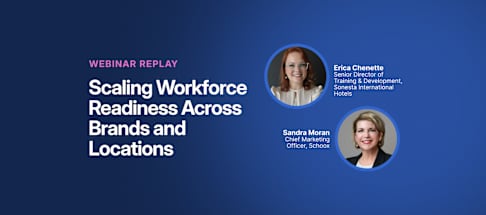
Scaling workforce readiness across brands and locations

See how 99% hotel franchisor and global brand Sonesta Hotels addresses the unique aspects of training in their multi-brand franchised business model and keeps every brand and location aligned, ready, and consistent.
You’ll learn how to:
  • Onboard at scale: Standardize the experience and training to ramp faster.
  • Tap into the power of your people: Build career pathways.
  • Position L&D as a business partner: Move from order taker to strategic partner.

What high-performing franchise organizations do differently

High-performing franchise organizations don’t just deliver training. They build workforce capability that drives consistent execution across locations, operators, and teams.

Get frontline teams productive faster without disrupting daily operations

The risk isn’t changing your LMS. It's what you're missing while you wait.

This isn’t about replacing your learning system. It’s about moving from tracking training activity to understanding workforce capability across your franchise network.

What feels risky

Rolling out a platform across franchisees feels complex

You can’t mandate training in every franchise agreement

Training feels “good enough” today

Implementation takes time

Managing multiple operators is challenging

What's actually risky

Offering training that franchisees opt out of because they aren’t convinced what it’s worth to their P&L

Bad guest experiences at one location are becoming the brand story for the whole system

Every quarter you wait, your brand standard drifts further from what guests actually experience

Underperforming properties quietly erode brand standards and revenue

Not having the data to connect training to revenue, retention, or guest experience

 Franchise organizations are shifting from training systems to performance systems

This isn’t just a platform change. It’s a shift in how workforce performance is managed across distributed franchise models.

Move from tracking training to understanding workforce capability

Drive adoption across frontline teams without disrupting operations

Improve consistency across franchisees, locations, and roles


What success looks like across franchise operations

The difference shows up in the metrics that run your business: productivity, consistency, retention, and revenue per location.
Across franchise industries like retail, fitness, automotive, and services, leading organizations are seeing:
  • Store and location managers spend less time re-training and more time driving performance
  • New hires contribute faster before turnover impacts results
  • Consistency across locations becomes the standard
  • Service quality improves across technicians, associates, and trainers
  • Corporate teams gain clear visibility across the entire franchise network

How high-performing franchise teams execute consistently

Get a practical guide built for franchise leaders who need training to influence real operational metrics.
You’ll learn:
  • How workforce skills connect directly to revenue, productivity, and retention
  • Why completion rates don’t reflect real readiness
  • How to improve onboarding speed and execution across stores, service teams, and locations

var(--fz-color-primary-3)

Anchor: FAQ

Is your current approach built for franchise complexity?

Can you see where capability gaps are forming across franchise locations before they affect performance?

Most organizations only identify issues after they appear in sales results, service delays, or customer complaints. Leading organizations surface gaps early.

Can training happen in the flow of work without disrupting operations?

Many teams still rely on training that pulls employees off the floor or out of the field. High-performing teams enable learning as part of daily work.

Can you connect workforce readiness to outcomes like revenue per location, service quality, or productivity?

Training is often measured by completion. Leading organizations focus on how readiness affects business performance.

When training isn’t mandated in every franchise agreement, how do you drive adoption?

You earn it. Adoption follows when franchisees can see, in their own results, that trained teams operate better, sell more, retain team members and protect the brand. Platforms that scale acro...

Can you maintain consistency across franchisees without adding complexity?

As franchise networks grow across regions and service lines, consistency often breaks down. Strong operators balance central standards with local flexibility.

Your brand is built at every location. Even the ones you don’t control.

The question isn’t whether training is happening. It’s whether your teams are ready to execute across every store, service call, job site, and shift. High-performing organizations don’t just deliver training. They ensure performance.