Anchor: Header

Your training system says “complete.” Does your production floor tell a different story?

Safety. Quality. Productivity. When workforce capability isn't consistent, manufacturers feel it immediately across every shift, line, and facility.

When execution breaks down, the floor pays for it first

Most systems in place today were built to track training completions. They weren't built to ensure every operator, technician, supervisor, and plant leader can perform consistently. In manufacturing, capability gaps don't show up in reports first. They show up in:

Inconsistent execution across plants, lines, and shifts

Increased downtime caused by workforce readiness gaps

Safety incidents tied to inconsistent training and reinforcement

Quality issues, scrap, and rework that impact production targets

Supervisors spending time re-training instead of improving operations

What high-performing manufacturing teams do differently

High-performing manufacturers don't just deliver training. They ensure every employee can execute safely, consistently, and confidently in real production environments.

Help employees become productive faster without pulling teams away from operations.

The risk isn't changing your LMS. It's what you're missing while you wait.

This isn't about replacing your learning system. It's about moving from a system that tracks training to one that identifies capability gaps and delivers targeted development to strengthen workforce performance.

What feels risky

Switching systems across facilities feels disruptive

Teams may resist adopting something new

Training feels "good enough" today

Implementation takes time

Rolling something out across multiple facilities feels complex

What's actually risky

Remaining reactive to workforce capability gaps every day

Teams aren't consistently engaging with the current system

You can't see where readiness gaps are forming until performance suffers

Downtime, safety issues, and quality problems continue unchecked

Inconsistent execution becomes accepted as normal

Manufacturers are shifting from training systems to workforce performance systems.

You're not just changing systems. You're changing how workforce performance is managed.

Shifting from training completion tracking to workforce capability management

Driving adoption across frontline teams without disrupting production

Improving consistency across facilities, shifts, and roles

What success looks like on the production floor

The difference shows up in the outcomes that drive manufacturing performance: safety, quality, productivity, and workforce retention.
Leading manufacturers are seeing:
  • Supervisors spend less time re-training and more time improving operations
  • New hires contribute faster before turnover erases the investment
  • Consistency across facilities becomes the standard, not the exception
  • Workforce skills evolve alongside operational and technology changes
  • Employees feel more confident in their roles and more likely to stay

The proof is on the floor Amsted Industries unified learning for 17,000 employees across 75 locations in 13 countries - replacing siloed systems with one platform. Its business units run independently, but now with full visibility for L&D.  
KIOTI Tractors grew its training capacity by 533%, developing consistent capabilities in far more of its workforce without adding administrative load.

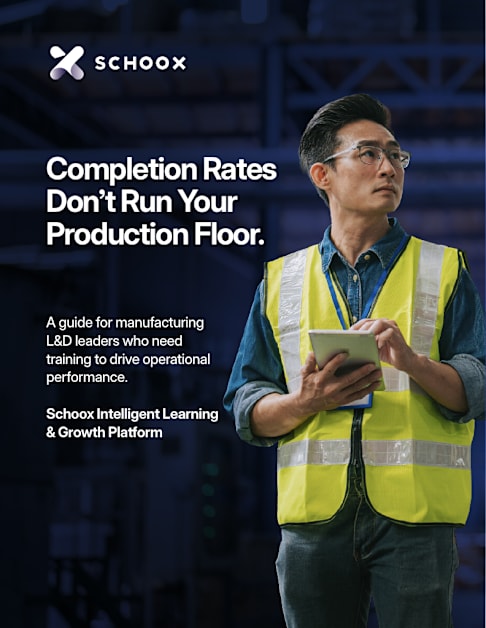
Completion rates don’t run your production floor

Get a practical guide built for manufacturing leaders who need learning to support operational performance, not just completions.
You'll learn:
  • How workforce skills influence safety, quality, productivity, and retention
  • Why completion rates don't tell the full story and what to measure instead
  • How to improve onboarding, workforce readiness, and consistency across facilities

var(--fz-color-primary-3)

Anchor: FAQ

Is your current approach built for manufacturing operations?

Can you identify workforce capability gaps before they affect production, safety, or quality?

Most organizations discover capability gaps after an incident, quality issue, or production disruption occurs. High-performing manufacturers surface and address them earlier.

Can learning happen in the flow of work without pulling employees off the floor?

Traditional training often requires employees to step away from production. The most effective organizations reinforce learning where work happens.

Can you connect workforce readiness to outcomes like productivity, safety, and quality?

Training is often measured by completions instead of performance. Leading organizations focus on how workforce capability influences operational results.

Can you maintain consistent standards across facilities while supporting local operational requirements?

As manufacturing organizations grow, consistency often becomes harder to maintain. Strong organizations balance centralized standards with facility-level flexibility.

Consistency doesn't happen by accident. It's built shift by shift.

The question isn't whether training is happening. It's whether your workforce is prepared to execute safely, consistently, and efficiently across every facility and every shift. The best operators don’t measure training by what courses are completed. They measure it by what results are delivered by their workforce.